




Vintage Sennheiser MD 421 U-5 for sale! Cardioid dynamic Microphone.
This is a highly sought after microphone in good condition. Tested - fully functioning. Has some normal wear due to age with some tape. Comes with a working clip!
The MD 421 is a well-known Sennheiser microphone of proven reliability and performance for many years now. Because of its excellent quality it is being used for almost all kinds of applications. The broadcasting stations use it for radio and TV field work, the musician prefers it for stage work as well as the recording amateur for home and outdoor recordings. The studio cardioid microphone MD 421 features a wide frequency response from 30 to 17,000 Hz. Its high sensitivity and slight increase in response towards high frequencies are responsible for its brilliant sound.
Details:
Cardioid Small Diaphragm Condenser
Acoustical mode of operation: Pressure Gradient Transducer
Frequency Response: 30 to 17,000 Hz
5 step bass attenuator switch
Weight ~ 370 grams
XLR 3 pin connector
Comes with microphone case
09040
Made in Germany
MD421-U
The MD 421-U is provided with a 3-pin Cannon plug (XLR). It is, as the other two models, a low-impedance mic which is symmetrically wired. A roll-off filter is provided. Two versions of the MD 421-U are available: MD 421-U-4 with adapter for ⅜-inch threads and MD 421-U-5 with adapter for ⅝-inch x 27G threads. The MD 421 N and the MD 421-2 are available in light grey heavy-duty finish. The models MD 421-U-4 and MD 421-U-5 feature a matt-black housing.
Directional Properties
The MD 421 has a cardioid directional characteristic which means that the maximum insensitivity to unwanted sound sources is at about 180°. The directional index of the MD 421 at 1000 Hz and 180° is at least 18 dB. This means that sound from the rear with a frequency of 1000 Hz produces an 18 dB lower signal as sound of the same intensity reaching the microphone from the front. As can be seen from the polar diagram, the MD 421 should therefore be spoken into directly from the front.
Adjusting the Roll-off Filter
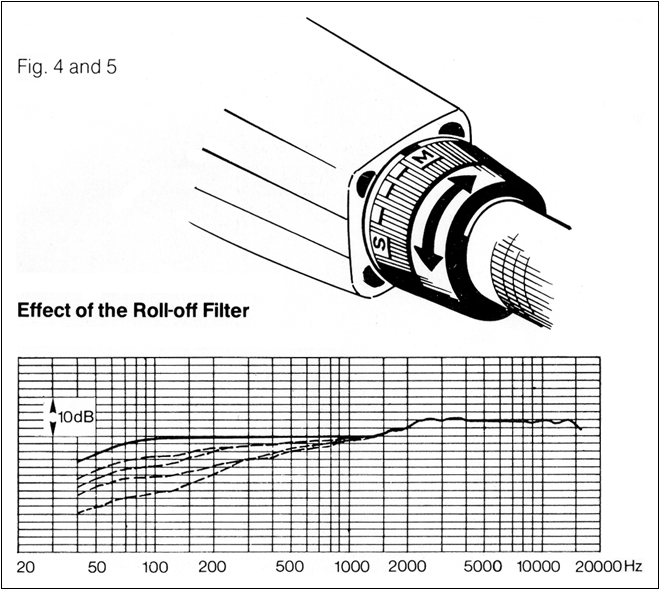
When a directional microphone is spoken into from a close distance, the lower frequencies are over-emphasized. If this effect is not desired it is possible to counteract or compensate for it by means of a roll-off filter. From the diagram showing the influence of the roll-off filter, it can be seen that in position M (music), the frequency response curve is not altered in any way. In position S (speech), however, the frequencies below 500 Hz are reduced by approximately 6 dB/octave. Between the positions M and S, the frequency response can be altered in three defined steps. See Figures 4 and 5.